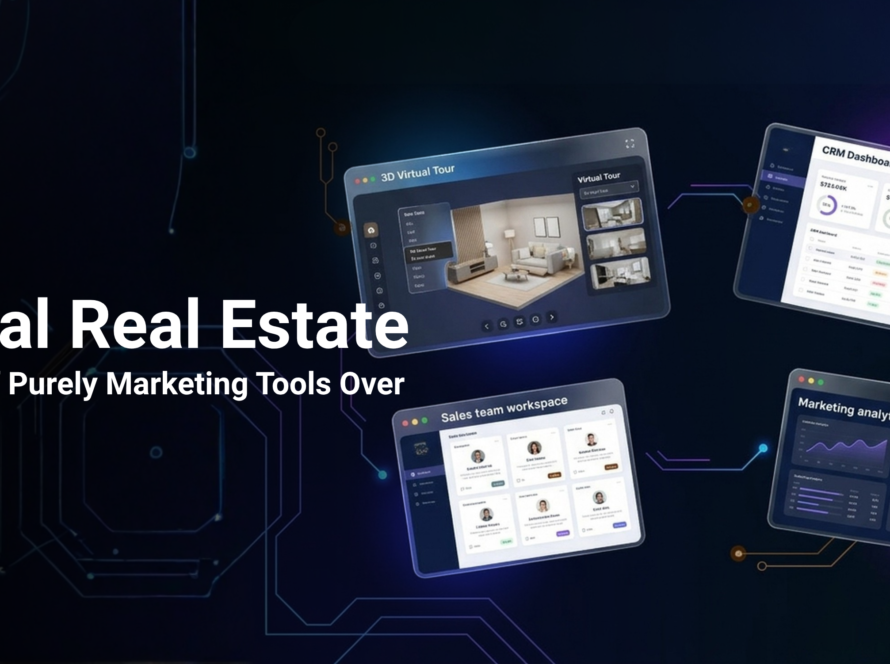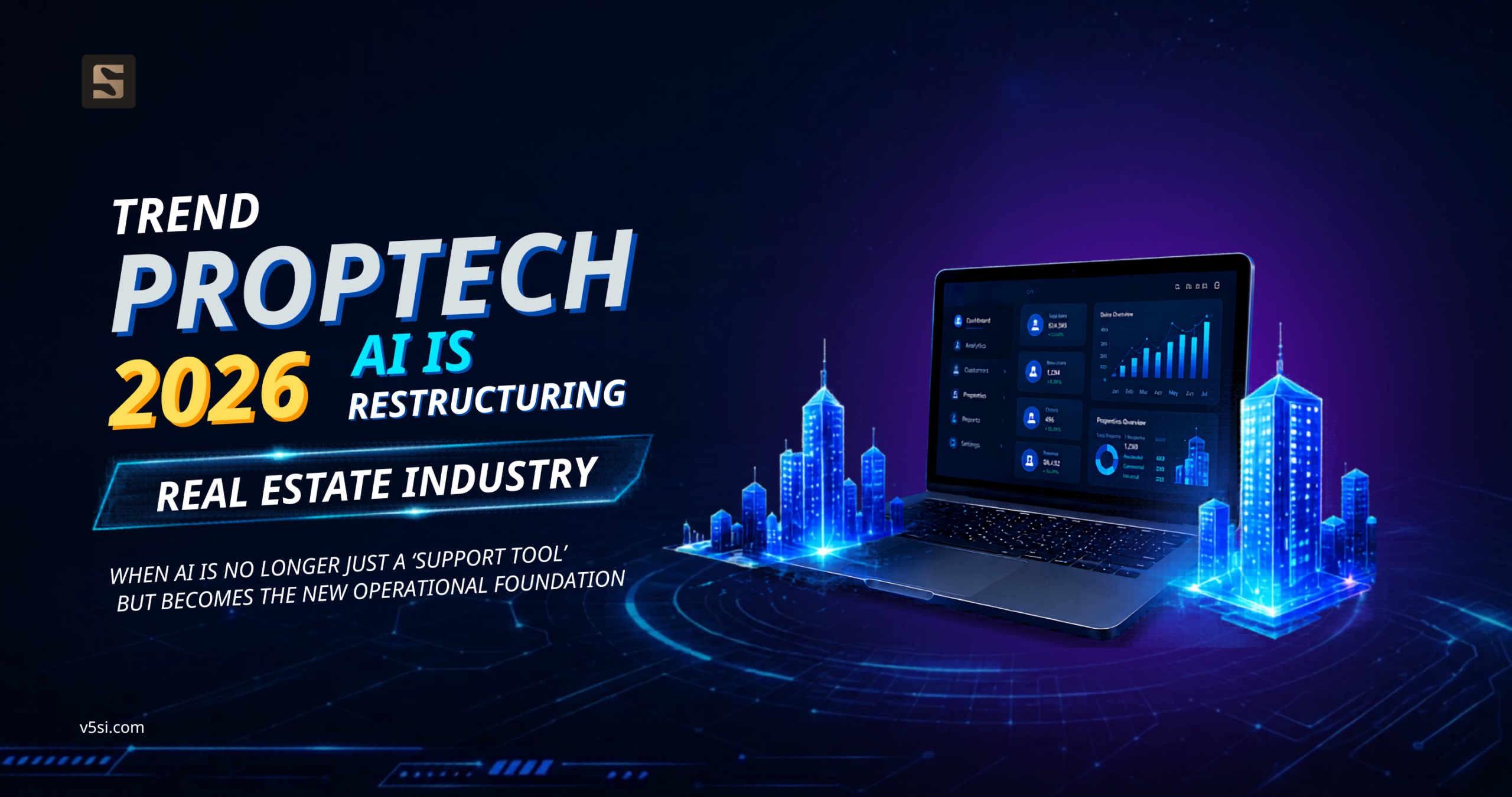
When AI is no longer a “support tool” but becomes the new operational foundation of the real estate sector.
While real estate marketing costs continue to rise and customers increasingly expect near-instant responses, many businesses are still operating with fragmented workflows, heavily reliant on personnel and manual processes.
By 2026, AI will no longer be a standalone support tool. It is becoming the new operational infrastructure of the real estate industry.
AI no longer just helps businesses work faster. It is restructuring the entire way the real estate industry operates, sells, and handles customer service. From developers, apartment operators, and leasing teams to sales and marketing systems—every department is directly impacted by the new generation PropTech wave.
Businesses that adapt early will optimize costs, accelerate operational speed, and create a long-term competitive advantage. Conversely, traditional models will increasingly face pressure regarding personnel costs, performance, and customer retention.
PropTech 2026 is Not Just “Technology for Real Estate”
Previously, PropTech was often simply understood as technological tools serving real estate, such as CRMs, listing websites, virtual tours, or tenant management software. But by 2026, PropTech has entered a completely different phase—where AI begins to directly participate in the entire business operation process.
AI-Driven Real Estate Operations New platforms are capable of analyzing customer behavior, automating the sales process, personalizing the buying and renting experience, providing 24/7 customer care, while simultaneously optimizing marketing performance and project operations in real-time.
This means AI does not just support a small part of the process; it directly participates in analyzing customer behavior through data to optimize the buying/renting experience, thereby accelerating sales conversion rates and optimizing project operational performance by:
- Automating the sales workflow
- Supporting 24/7 customer care
- Automating marketing
- Centralizing data management
- Predicting demand and conversion rates
This creates a massive shift: Real estate businesses now compete not only on location and product but also on operational speed and technological experience.
This is also why many real estate businesses worldwide have deployed AI-integrated PropTech platforms like VTouch to optimize operational experiences and customer interactions.
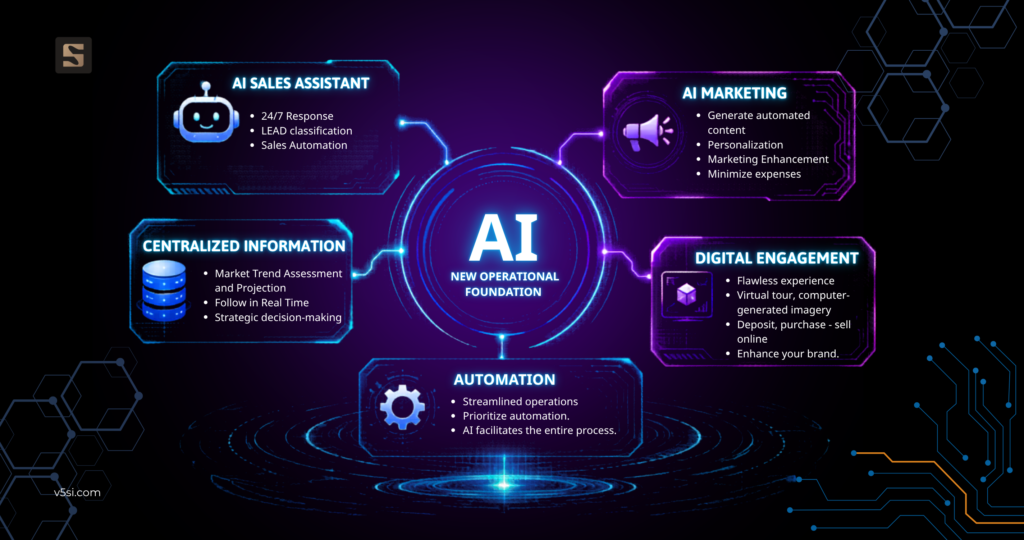
5 PropTech Trends in 2026 Real Estate Businesses Cannot Ignore
1. AI Sales Assistant: Optimizing Conversion Rates & Managing Personnel Risks
One of the most obvious changes is the strong emergence of AI Sales Assistants.
According to many international PropTech reports, most customers today expect a response within the first few minutes of sending an inquiry, especially in the rental and high-end property segments. Customers expect faster responses, more accurate information, and a more personalized experience during their real estate search. Meanwhile, traditional sales models often face limitations such as slow response times, inconsistent information, or missed clients outside working hours, and rely heavily on individual capabilities.
AI Sales Assistants are becoming the solution to help businesses prevent Lead Leakage and optimize Customer Lifetime Value (CLV):
- 24/7 customer response: Ensuring no leads are missed outside of office hours.
- Automated lead scoring: Evaluating potential to prioritize nurturing.
- Process automation: Scheduling house viewings, handling deposits, etc.
- Data synchronization: Syncing customer data across the entire system.
Especially in the market for apartments for rent, condotels, serviced apartments, and mixed-use projects, response speed almost directly impacts conversion rates. AI Assistants significantly offload unnecessary repetitive tasks from the sales team.
New-generation AI Assistants today, such as the AI Chatbot Assistant tool, not only support customer responses but also have the ability to synchronize data and automate many sales tasks in real-time.
2. AI Marketing: Scaling Up Without Increasing Headcount
One of the biggest pressures on real estate businesses is rising advertising costs, while the continuous demand for content production across multiple platforms puts immense pressure on personnel and budgets. This makes it very difficult to maintain a consistent, professional presence across various social media platforms or media channels.
In 2026, current AI tools can help optimize the marketing funnel and minimize Customer Acquisition Cost (CAC) by:
- Automatically generating project flyers
- Creating social media content
- Producing short-form videos
- Personalizing content and publications for each customer segment
The greatest value lies not only in creating content faster but in the ability to help businesses scale up their marketing operations without a corresponding increase in operational staff.
Many businesses have now started applying tools like AI Designer to automate the process of creating visual marketing, flyers, and social content at a significantly faster pace.
3. Centralized Data: Real-time Decision Making
Many businesses currently still manage data in a fragmented way through Excel or systems lacking integration between sales, marketing, and operations. This leads to lead leakage, difficulty evaluating effectiveness, slow decision-making, and limited scalability.
PropTech Trends 2026 focus on building smarter and centralized data systems. This means all customer, project, booking, operational, and customer care data is centralized and analyzed by AI.
This helps business leaders:
- Predict customer demand
- Evaluate sales performance
- Optimize marketing costs
- Track real-time conversion rates
- Improve the tenant/buyer experience
Over the next 3–5 years, businesses possessing robust data systems will have a massive competitive advantage.
4. Digital Experience: The Solution for Brand Valuation
Modern users are increasingly impatient with complex processes, slow responses, or unprofessional project visuals. They want to view information quickly, receive instant support, book online, and experience more intuitive, interactive formats.
This makes the technological experience an increasingly vital competitive factor, on par with a project’s location, amenities, or price.
In many cases, the technological experience is the very differentiator between two comparable projects. For high-end real estate, a CGI render is never just an image; it is a genuine promise of a future living experience.
In a context where customers increasingly make decisions based on a digital-first experience, the quality of visual presentation and CGI visualization further asserts its importance in high-end real estate marketing strategies. Many developers today are investing heavily in CGI solutions and architectural visualization to enhance their ability to attract customers right from the pre-sale stage, typically seen in projects executed by CAV Studio.
5. Automation: Shifting to a Lean Model
In a continuously fluctuating market, expanding personnel for growth is no longer the optimal solution. This leads to a trend where real estate businesses are strongly pivoting to a lean operational model with the following criteria:
- Lean operations.
- Automation-first approach.
- AI-supported workflows.
Businesses are increasingly prioritizing process automation to reduce operating costs, accelerate workflows, limit manual errors, and enhance team performance. Even small and medium enterprises (SMEs) are starting to invest heavily in AI and PropTech to maintain competitiveness. This is no longer a strategy exclusively for large corporations but is gradually becoming an industry-wide trend.
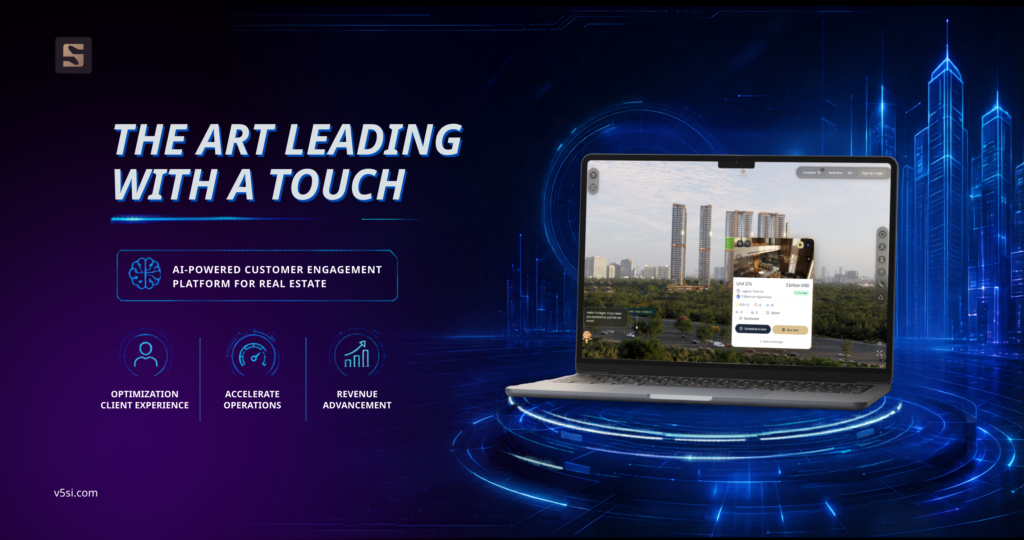
The Important Thing is Not “Whether to Use AI or Not”
The most important thing today is where AI is integrated into the operational model. Many businesses still only use AI for isolated tasks like writing content, basic chatbots, or a few small automated tools.
But leading businesses are going further by building an entire ecosystem around AI, including:
- A centralized data ecosystem.
- Automated operational processes.
- Seamless AI workflows.
- Consistent customer experiences.
The differentiator in the next 2–3 years will lie in the ability to integrate AI into overall business operations, rather than just using it as a standalone tool. Instead of executing marketing manually, many businesses are shifting to AI-integrated CMS systems to automate content workflows and maintain a more effective cross-platform presence.
V5SI and the Future of Next-Generation PropTech
Over the next 3–5 years, AI will no longer be a competitive advantage reserved for pioneering businesses but will gradually become the new operational standard for the entire real estate industry. Early adopters will gain a significant advantage in speed, data, customer experience, and future scalability.
At V5SI, we believe that the future of the real estate industry will be shaped by AI, data, automation, and digitized customer experiences. That is also why V5SI focuses on developing solutions that help real estate businesses:
- Optimize operations & reduce management costs.
- Enhance sales performance.
- Improve the customer experience.
- Increase scalability.
If your business is looking for AI-applied PropTech solutions to optimize operations, elevate the customer experience, and boost business efficiency, V5SI is ready to accompany you in building a suitable technology ecosystem for every real estate model.